
Search Hawaii Court Dockets
Hawaii court dockets are official case records maintained by the State Judiciary across all four judicial circuits. They cover criminal, civil, traffic, family, land, and tax appeal cases filed at courts statewide. The eCourt Kokua public access system lets anyone search Hawaii court dockets at no charge. Basic case details like party names, case status, and scheduled hearings are available for free. For copies of documents from the case file, small fees apply. This page covers how to search the Hawaii court docket system and where to get court records from any circuit.
Hawaii Court Docket Overview
Where to Find Hawaii Court Dockets
The Hawaii State Judiciary runs the main public access portal for court dockets. It is called eCourt Kokua. You can reach it through the courts.state.hi.us website. eCourt Kokua covers all Hawaii courts, including District Courts, Circuit Courts, Family Courts, Land Court, Tax Appeal Court, the Intermediate Court of Appeals, and the Supreme Court. The search runs around the clock and costs nothing to use. No account is needed for basic case lookups. eCourt Kokua pulls data from JIMS, the Judiciary Information Management System, which is the central database behind every court in the state. New filings generally appear within three business days. Some case types are sealed and will not show in public searches. Family Court matters involving minors are among the most common confidential case types.
The Legal Documents Branch at each courthouse handles records requests for documents not available online. You can go in person or send a written request by mail. In-person service at most locations runs from 8 a.m. to 1 p.m. Monday through Friday. Mail requests may take 10 to 20 business days. The court mails an invoice before copies are made, so do not send payment with your initial request. Check the how to access court records page on the Judiciary website for details specific to each court type.
Note: Family Court cases involving minors do not appear in eCourt Kokua and require a court order or prior approval before they can be accessed.
Searching Hawaii Court Dockets Through eCourt Kokua
eCourt Kokua offers three search types. You can search by case ID number, by party name, or by vehicle information for traffic cases. Case ID searches need the case number in one of two formats. The newer JIMS format looks like "1PC151005678." The older legacy format looks like "CR-15-1-5678." If you have the case number, this is the fastest option. Party searches let you look up by first name, last name, or business name. Adding a date of birth can narrow results when many records share a name. Vehicle searches are for traffic cases only, using a license plate number or a VIN. When results come back, you see a case summary showing party names, case type, filing date, current status, and any scheduled hearing dates. Documents available for purchase appear with a PDF icon. Not every document in a case file will be there online. Some must be requested at the courthouse directly.
The eCourt Kokua public access system is the primary tool for searching Hawaii court dockets, covering all four judicial circuits in a single interface.
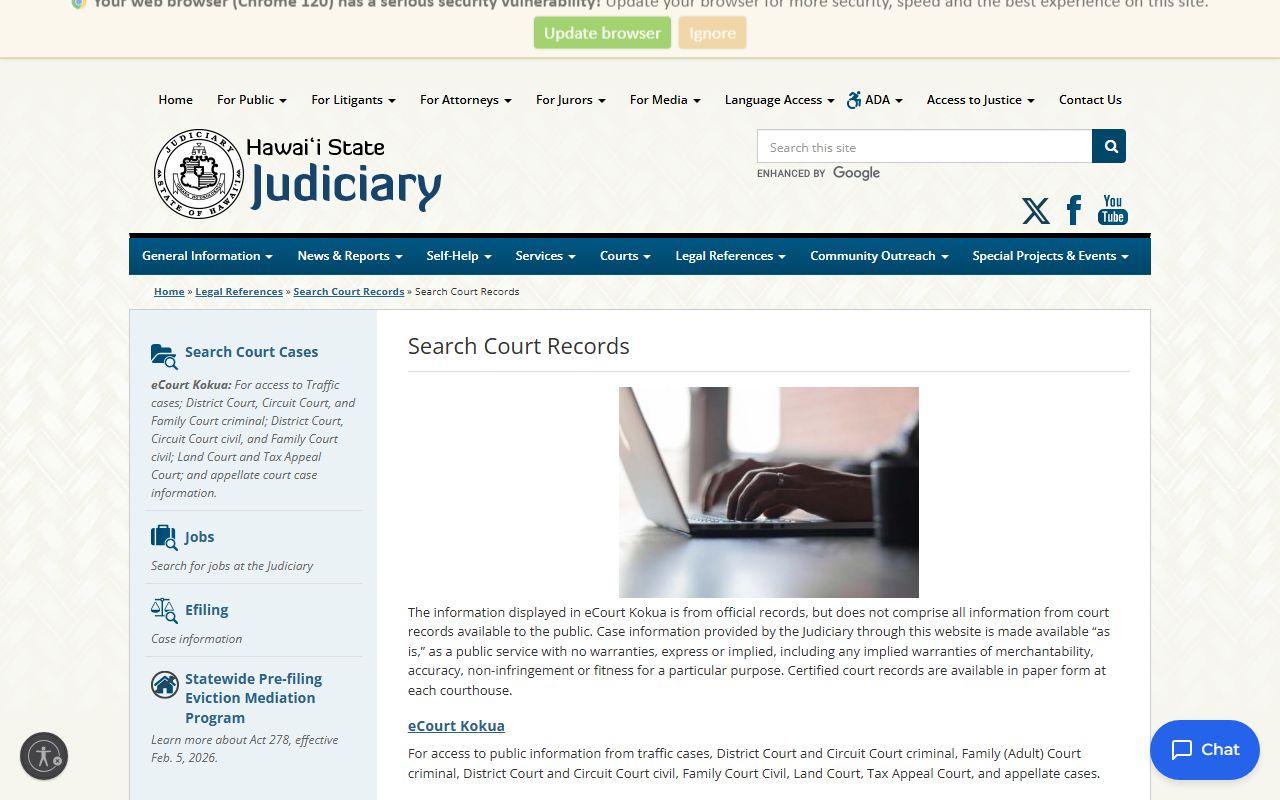
eCourt Kokua displays live case data from across the state, including case status, party names, upcoming hearing dates, and document availability for all publicly accessible Hawaii court dockets.
Documents with a PDF icon cost $3 for the first 30 pages. Pages beyond 30 cost $0.10 each. If you pull court records often, subscription plans are available. A quarterly plan runs $125. An annual plan costs $500. Both give unlimited downloads of all publicly available documents marked with a PDF icon. The subscription does not unlock sealed or confidential records. It only covers documents already visible to the public. For people who need just one or two documents, paying per download is usually cheaper. Researchers and attorneys who pull records regularly often find the annual plan saves time and money over the course of a year.
Note: Documents filed in court may not appear in eCourt Kokua right away, but most new filings show up within three business days of submission.
What Hawaii Court Dockets Contain
A Hawaii court docket is the official case log. It tracks every document filed and every action taken from the day the case was opened through its final resolution. The docket lists dates, document titles, and brief descriptions of what was filed or ordered. For criminal cases, you can see charge information, bail status, hearing history, and the final disposition. Civil dockets show the complaint, responses, motions, and judgment. Family Court dockets cover divorce petitions, custody orders, and child support orders. Traffic dockets show citation details, hearing dates, and the outcome. The docket itself is a table of contents for the case file. Reading the actual text of a document means either buying the PDF through eCourt Kokua or requesting a copy at the courthouse.
Hawaii courts handle a wide range of case types. Circuit Courts take felony criminal cases and civil matters over $40,000. They also manage probate, guardianship, conservatorship, and estate work. Land Court handles property title disputes. Tax Appeal Court covers tax cases. District Courts take misdemeanors, traffic violations, civil cases under $40,000, small claims under $5,000, landlord-tenant disputes, and temporary restraining orders. Family Courts handle divorce, child custody, adoption, juvenile delinquency, and domestic abuse cases. The Intermediate Court of Appeals and the Supreme Court handle appeals from all lower courts. Each case type generates its own docket entry in the JIMS system. Older records may not be fully digitized, so for very old cases, contact the Legal Documents Branch at the relevant courthouse to ask about archive availability before assuming the file is online.
Hawaii court dockets typically show the following information:
- Party names, status designations, and identifying details on file
- Case type, case number, and original filing date
- All documents submitted to and accepted by the court
- Scheduled and past hearing dates with courtroom assignments
- Court orders, rulings, and judgment information
- Current case status and final disposition if closed
Some records are sealed by law. Juvenile cases, sealed adult records, and certain family court filings are restricted. The Hawaii Court Records Rules define exactly what is public and what is not.
Criminal History Records in Hawaii
Court dockets and criminal history records are not the same thing. A court docket tracks what happened in one specific case. A criminal history record summarizes all adult convictions tied to one person across every case in the state. In Hawaii, the Hawaii Criminal Justice Data Center, known as HCJDC, manages criminal history records. It operates under the Department of the Attorney General. HCJDC records are sometimes called a "Police Clearance" or a "Police Abstract." These records only cover adult criminal convictions. Non-convictions and pending cases are not part of the public-facing data. Juvenile records are also excluded. Those must be requested from the Hawaii State Judiciary Family Court Juvenile Records office at 808-954-8190.
The HCJDC maintains the eCrim online system for adult criminal conviction searches. Each name search through eCrim costs $5. A certified criminal history record costs $12. eCrim runs 24 hours a day. Results are emailed after payment. Searches can be run by name, date of birth, social security number, and gender. For in-person checks, the HCJDC main office is at 465 S. King Street, Room 102, Honolulu, open Monday through Friday 8 a.m. to 4 p.m., closed noon to 1 p.m. The office does not take cash. Accepted payments include credit, debit, Apple Pay with a 3% service fee, money orders, and cashier's checks. An in-person name check costs $30, with an optional $20 for certification and free notarization. Standard processing takes 3 to 5 business days. Requests with a notary may take 7 to 10 business days.
The HCJDC website has full details on how to order criminal history records online or in person.
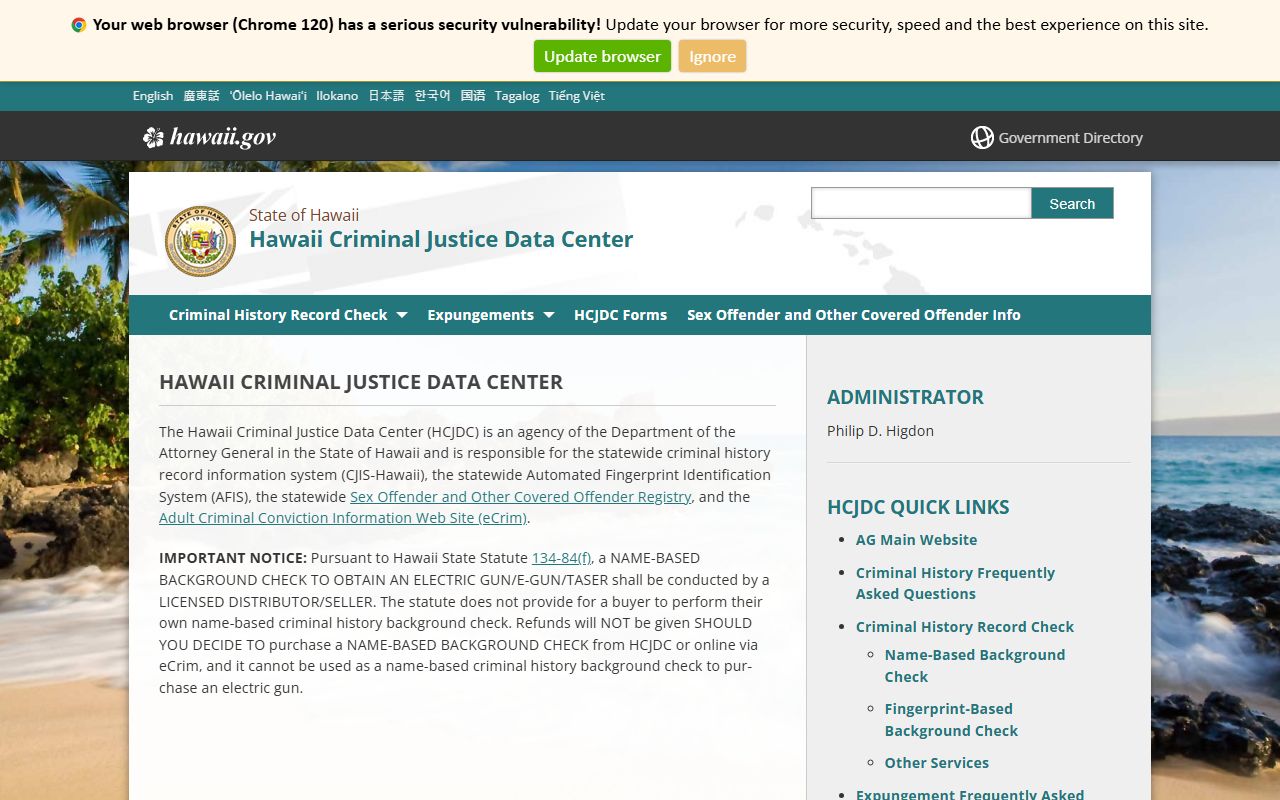
The Hawaii Criminal Justice Data Center manages statewide conviction records separate from the court docket system, with online access through eCrim available around the clock for $5 per name search.
Hawaii's Four Judicial Circuits
Hawaii is divided into four judicial circuits. Each covers a different part of the state. The First Circuit covers Oahu. It handles the largest case volume in Hawaii and operates court facilities at multiple locations across the island, including Ka'ahumanu Hale for Circuit Court and Kauikeaouli Hale for District Court. The Second Circuit covers Maui County, which includes Maui, Molokai, and Lanai. Its main courthouse is Hoapili Hale at 2145 Main Street in Wailuku. The Third Circuit covers Hawaii County on the Big Island. It has two main facilities, one at Hale Kaulike in Hilo for East Hawaii and one at the Keakealani Building in Kealakekua for West Hawaii. The Fifth Circuit covers Kauai County. Its courthouse is the Pu'uhonua Kaulike Building in Lihue, where Circuit Court, District Court, and Family Court all share the same building. There is no Fourth Circuit. Kalawao County, the smallest county in the United States, has no court facilities and falls under the Second Circuit in Wailuku for all legal matters.
The Hawaii Supreme Court and the Intermediate Court of Appeals both sit at Aliiolani Hale, 417 South King Street in Honolulu. They hear appeals from all four circuits. Supreme Court opinions and ICA decisions are available online at no charge. Oral arguments at the Supreme Court are open to the public and can be streamed on the Judiciary's YouTube channel.
The First Circuit District Court serves Oahu residents at several courthouse locations across the island, each handling cases for its specific geographic area.
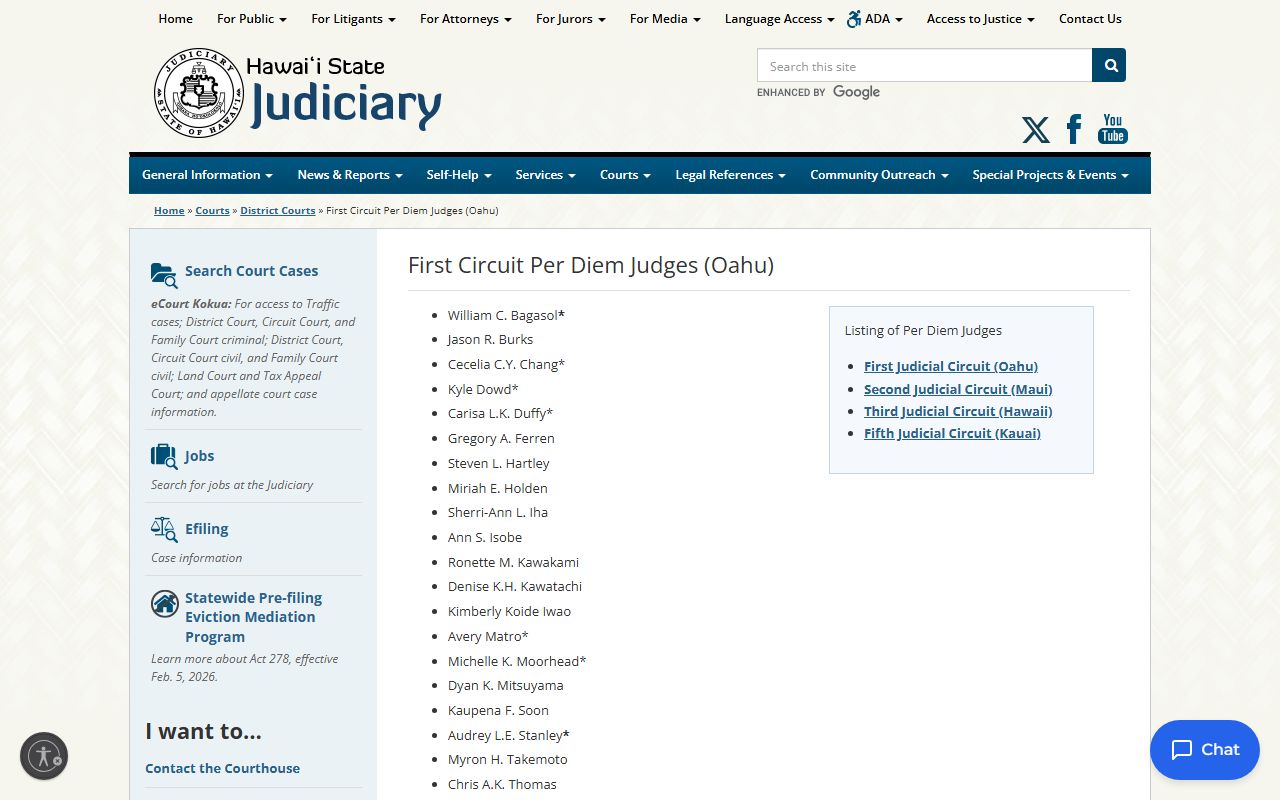
The First Circuit District Court portal covers multiple courthouse locations on Oahu, all searchable through eCourt Kokua for case lookup and docket access.
In-Person Access at HCJDC Public Access Sites
If you need a printed criminal record and prefer an in-person visit, HCJDC operates Public Access Sites at several locations across the state. Each printout costs $25. You need the person's name, social security number, sex, and date of birth to run the search. Payment is by money order, cashier's check, or cash only. No credit cards are accepted at these sites. The information available in person is the same as what eCrim provides online. The cost is higher for the in-person visit, but some requesting agencies require an original printout. Call ahead to confirm office hours before making a trip.
The HCJDC Public Access Sites page lists all in-person locations statewide where printed criminal conviction records can be obtained.
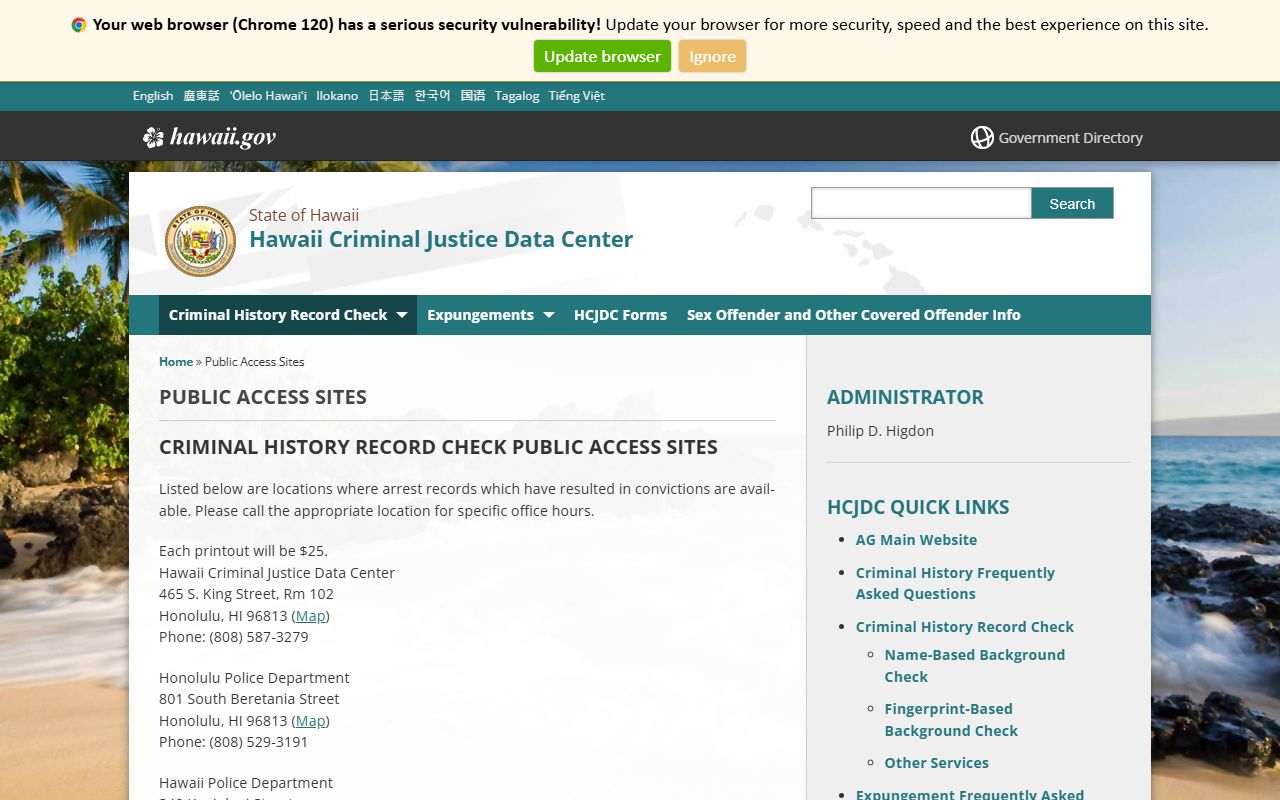
Each public access site provides the same conviction data available online through eCrim, with in-person printouts costing $25 and requiring payment by money order, cashier's check, or cash.
Public Access Site locations for criminal history records include:
- Hawaii Criminal Justice Data Center, 465 S. King Street Rm 102, Honolulu, (808) 587-3279
- Honolulu Police Department, 801 South Beretania Street, Honolulu, (808) 529-3191
- Hawaii Police Department, 349 Kapiolani Street, Hilo, (808) 961-2233
- Kona Police Station, 74-5221 Queen Kaahumanu Highway, Kailua-Kona, (808) 326-4646 ext. 286
- Kauai County Police Department, 3990 Kaana Street, Lihue, (808) 241-1661
- Maui County Police Department, 55 Mahalani Street, Wailuku, (808) 244-6345
Hawaii Court Records Access Rules
The Hawaii Court Records Rules govern public access to court files across the state. Rule 3 establishes a general policy in favor of public access. Rule 4 identifies cases and records not subject to public access, including confidential Family Court cases involving minors and records that courts have sealed. Rule 5 covers remote access to electronic court records, which applies directly to eCourt Kokua. Rule 9 requires parties to protect personal information in their filings, such as social security numbers and bank account numbers. These rules apply to all courts in the state and are separate from the general public records law.
Hawaii's general public records law is the Uniform Information Practices Act, or UIPA. It is codified in Hawaii Revised Statutes Chapter 92F. The UIPA applies to state and county agencies and requires them to respond to written records requests within 10 business days. It mandates disclosure of records unless a specific exemption applies. Court records operate under the Court Records Rules rather than the UIPA. But the UIPA does apply to police reports, corrections records, and other agency documents that may be relevant to a court case. The Office of Information Practices, or OIP, oversees UIPA compliance and can mediate disputes when a records request is denied.
Note: Under the UIPA, copy fees are typically $0.10 per page for standard documents, and the first hour of search and review time is provided at no charge.
Upcoming Court Hearings in Hawaii
The Hawaii State Judiciary added an upcoming hearings search to eCourt Kokua. The feature launched in August 2023 and gives a two-week view of scheduled court dates. You can search by case ID to see all hearings for that specific case. You can also search by court location to see every hearing scheduled in a particular courtroom. The tool covers Circuit Courts, District Courts, Land Court, and Tax Appeal Court. Family Court matters involving minors are excluded. The system updates in real time as new hearing dates are entered. Each courthouse also continues to post daily calendars at its location. Remote hearings may include video conference links when available. Contact the Judiciary communications office at pao@courts.hawaii.gov or 808-539-4909 with questions about the hearings search.
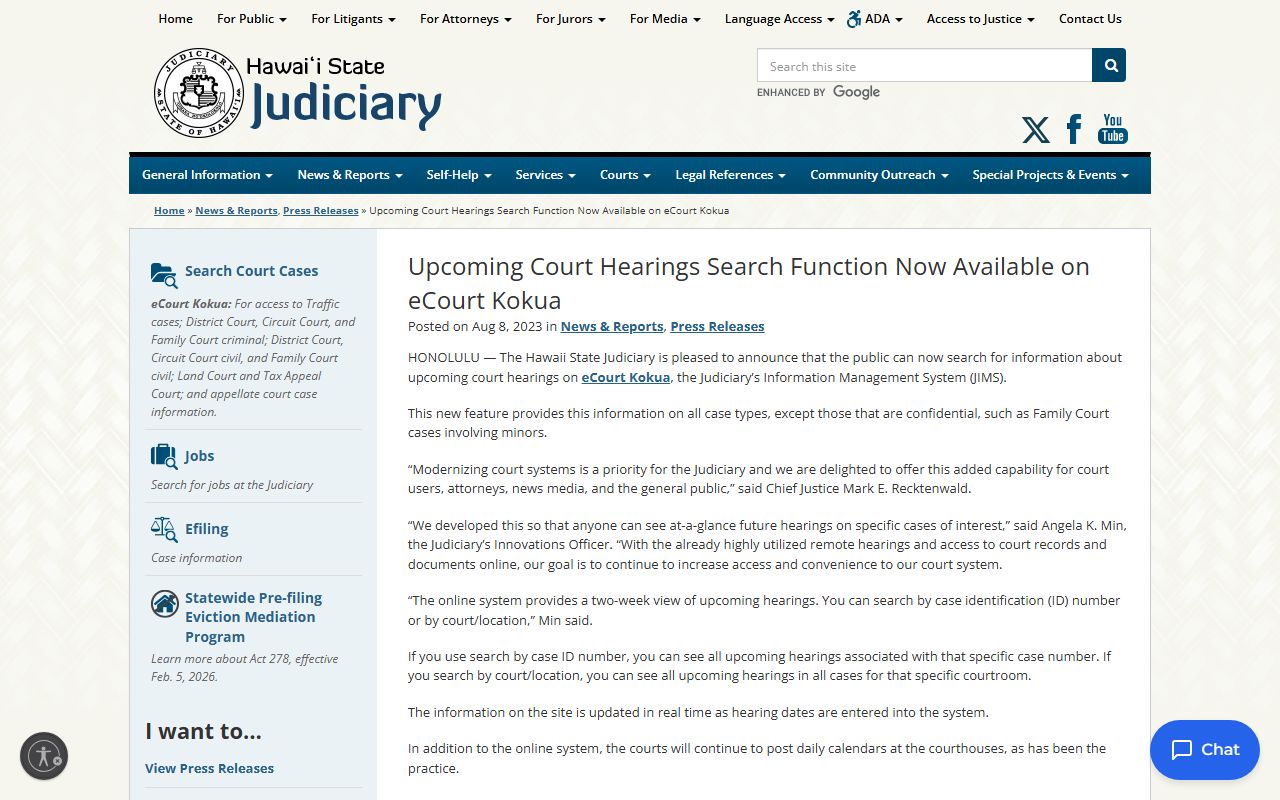
The upcoming hearings calendar in eCourt Kokua is updated in real time and covers Circuit, District, Land, and Tax Appeal courts across all four Hawaii judicial circuits.
How to Get Copies of Hawaii Court Records
To get copies, start with eCourt Kokua for documents available online. For anything not in the system, contact the Legal Documents Branch at the courthouse where the case was filed. You fill out records request form 1CP858. Staff pull the case and the documents you need. If you do not have a case number, a $5 name search fee applies. Circuit and Family Court copies cost $1.00 per page. Certified copies cost an additional $2.00 per document. Do not send payment with your initial request. The court sends an invoice first. For mail requests, use a money order or cashier's check. Cash is not accepted by mail. Mailed responses may take 15 to 20 business days and come by U.S. mail only.
For downloadable court documents through eCourt Kokua, the fee is $3 for the first 30 pages and $0.10 per page after that. Opinions and orders from the Supreme Court and the Intermediate Court of Appeals are available at no charge. For the Fifth Circuit in Kauai, the Pu'uhonua Kaulike Building at 3970 Kaana Street in Lihue handles records for Circuit, District, and Family Court cases filed on Kauai. Copy fees there are $1.00 per page for standard copies and $2.00 additional for certified documents. For the Third Circuit on the Big Island, the Legal Documents Branch at Hale Kaulike in Hilo handles records for East Hawaii cases, and the Keakealani Building in Kealakekua covers West Hawaii. Call the Legal Documents Branch at the relevant courthouse before visiting to confirm their current requirements.
Note: In-person service at most Legal Documents Branch offices runs 8 a.m. to 1 p.m. Monday through Friday, except state holidays.
Browse Hawaii Court Dockets by County
Hawaii has four judicial circuits covering five counties. Each county has its own courthouse and court system. Select a county below to find local courthouse contact information, court types, and resources for searching court dockets in that area.
Court Dockets in Major Hawaii Cities
Residents of Hawaii's largest communities file cases at the Circuit or District Court serving their area. Select a city below to find courthouse locations and resources for searching court dockets there.